Tuesday, October 11, 2011

Come see us at MLA Annual Conference 2011

Session Title: Minnesota Library Futures Initiative
Tracks: Administration & Leadership

When: Friday, Oct. 14 from 9:30 to 10:30

Presenters: Members of the Minnesota Library Futures Initiative

Description: In October 2010, a group of 24 early career librarians from all library types met for the first time to start envisioning the year 2025. Since that time, the Futurists have investigated
potential economic, social, technological, and other trends
to craft an idea of what libraries—and library patrons—will
look like in the next 15 years. Join the Futurists for a brief overview of their work and a preview of what’s in store for Minnesota’s libraries in 2025. During the session, the Futurists hope to help library staff start thinking about what might be done to prepare for the changes to come. In line
with how the Futurists have approached their task, this presentation will be philosophical in nature rather than focused on the latest gadgets and fads.

Yum! Design.

The Design section of the New York Times is featuring the Children’s Library Discovery Center in the Queens Central Library in downtown Jamaica.

"Today libraries double as centers for the elderly and toddler playrooms. They’re safe after-school havens for teenagers of working parents, with rooms set aside that are stocked with computers and, at a few branches, like the Rockaways, even with recording studios."

"Libraries have also learned from retailers like Starbucks and Barnes & Noble about what people expect when they leave their homes to go someplace public to sit and read. Libraries have become modern town squares and gathering places; they offer millions of New Yorkers employment counseling, English-language classes and, crucially, Internet access. Quiet rooms, like those Carnegie built, tend to be smaller and set aside these days, almost like smoking sections in airports."
"Is that a bad thing? Times change. Research libraries still survive. To imagine that libraries could remain as they were half a century ago would entail wishing away the Web and the demands of old people, immigrants, the unemployed, schoolchildren and parents who want constructive places to keep their young children occupied at a time when public resources and political good will are in increasingly short supply."

Read more at http://www.nytimes.com/2011/10/11/arts/design/new-yorks-public-architecture-gets-a-facelift.html

Wednesday, August 24, 2011

What students don't know

This has been making the rounds in the higher ed circles. One of my colleagues mentioned that a faculty member contacted her as a result of reading this...if only we could all be so lucky.

What students don't know: study of student research habits

"...have learned over the course of a two-year, five-campus ethnographic study examining how students view and use their campus libraries: students rarely ask librarians for help, even when they need it. The idea of a librarian as an academic expert who is available to talk about assignments and hold their hands through the research process is, in fact, foreign to most students. Those who even have the word “librarian” in their vocabularies often think library staff are only good for pointing to different sections of the stacks."

"At Illinois Wesleyan University, “The majority of students -- of all levels -- exhibited significant difficulties that ranged across nearly every aspect of the search process,” according to researchers there. They tended to overuse Google and misuse scholarly databases. They preferred simple database searches to other methods of discovery, but generally exhibited “a lack of understanding of search logic” that often foiled their attempts to find good sources."

Wednesday, August 17, 2011

What is a Beta Sprint?

Interesting ideas on the Digital Public Library of America:


and this just announced...

After a careful selection process, the Digital Public Library of America (DPLA) Steering Committee is thrilled to announce the eight members of the Beta Sprint Review Panel. The panel will convene in early September to review the Beta Sprint submissions. The creators of the most promising betas will be invited to present at the October 21, 2011 public plenary meeting in Washington, DC.

The panel is composed of public and research librarians and experts in the fields of library science and information management from around the country:

Patsy Baudoin, MIT Libraries
Maeve Clark, Iowa City Public Library
Laura DeBonis, former Director for Library Partnerships for Google Book Search
Eli Neiburger, Ann Arbor District Library
David Rumsey, David Rumsey Map Collection
Michael Santangelo, Brooklyn Public Library
John Weise, HathiTrust
Jessamyn West, library technologist

Tuesday, July 12, 2011

Hooray, more standards! Now what?

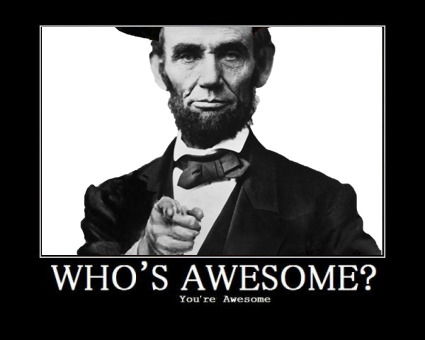
The Information Literacy Standards for Teacher Education were recently published. So what? You're probably only reading this because of the awesome picture to the right.

Here's a small call for action, either through our MNLFI final project or an MLA committee down the road or a post-apocalyptic rewrite of the US education system. Librarians--this includes me--please work with your program directors or deans or instructional designers or faculty members to promote information literacy education. Collaborate with those in the education field to find out where these standards fit into current education program and state licensure requirements. (Seems like that might be the easiest door in which to wriggle through. I don't know.) Be prepared to suggest assignment augmentations or in-class projects that reflect these standards/objectives. Consider talking with your School Library Media Specialist friends to see if they know anything about these new standards, or if they have any great ideas for implementation.

These standards, if adopted by teacher education programs, can help our teachers better know how to teach students to become more information literate (and how to assess and evaluate said growth). But the standards won't get adopted on their own. Instead of reading them, thinking "that's good that someone came up with these," and shrugging them off, expend a little energy trying to get ACRL's work into action at your college or university. Just try! I'm going to. I'll let you know how it goes.

Thursday, June 30, 2011

Tuesday, June 28, 2011

Corporate Culture at Netfilx

A few things in the powerpoint from Netflix CEO Reed Hastings made me think about Libraries and why we are resistant to change--we were really good at what we did (and still are) with collecting, organizing and providing access to books but....


Something about these processes seemed eerily familiar...


What do you think?